

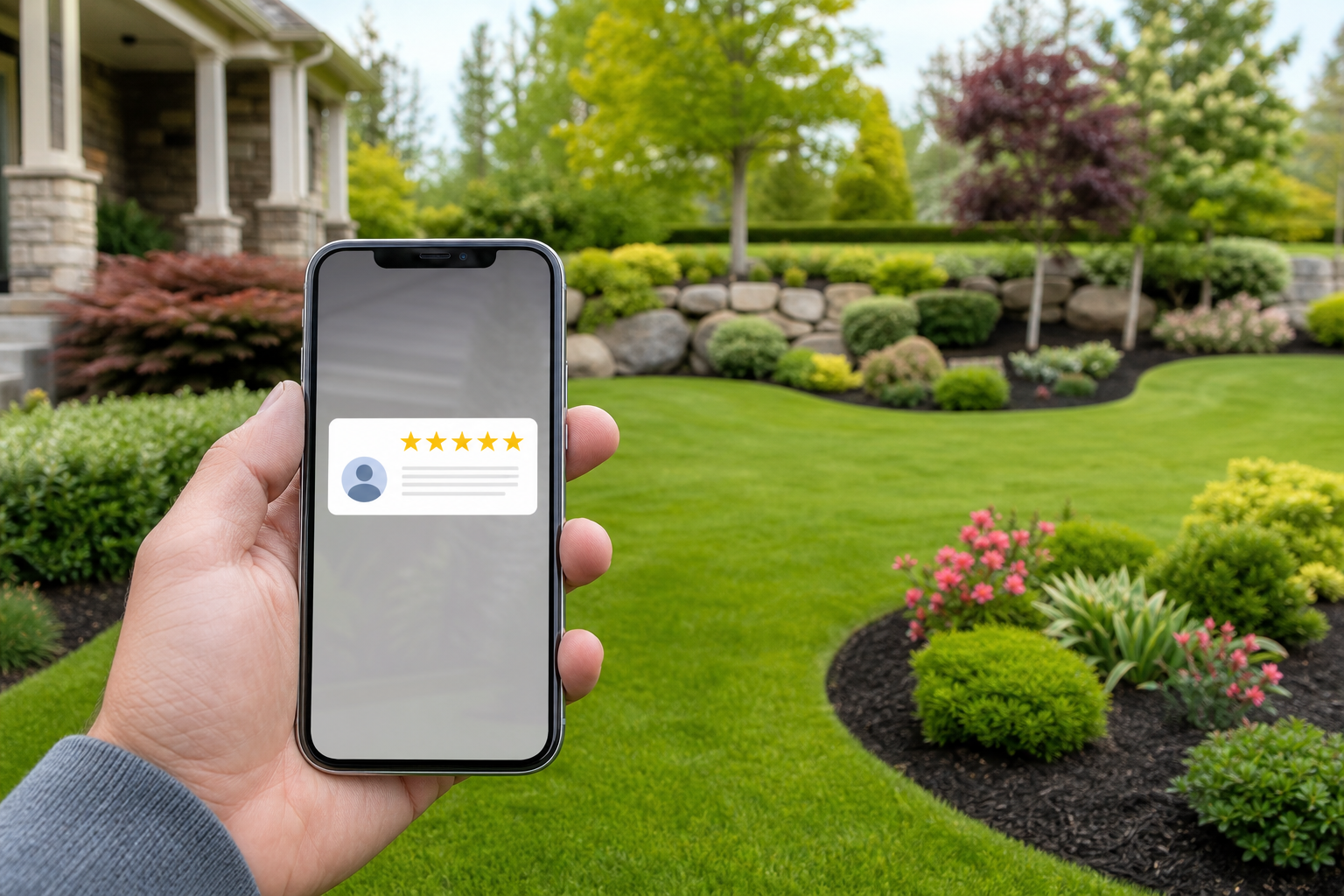
Landscaping companies have something most service businesses envy: the work photographs beautifully. A paver patio transformation, a drainage solution that saved a backyard, a four-season planting plan coming into bloom—this is visual, shareable, scroll-stopping content.
But having great project photos and a solid reputation in your market doesn't automatically produce a steady pipeline of new leads. You also need local search visibility so homeowners can find you, a review presence that reinforces trust, clear lead paths that make it easy to reach out, and measurement so you know what's working and what's wasting money.
This post covers how those pieces fit together in a coordinated landscaping marketing approach—and where most landscaping companies leave opportunities on the table.
Local Search Visibility: Getting Found First
When a homeowner searches "landscaping company near me" or "patio installation [city]," the companies that show up in the top results and the local map pack get the majority of clicks. For landscapers, local search visibility is the foundation of digital marketing because your customers are almost always searching with geographic intent.
Google Business Profile Optimization
Your Google Business Profile (GBP) is often the first thing a potential customer sees—sometimes before they ever visit your website. Key optimization areas include:
Accurate categories: Select your primary and secondary categories carefully. "Landscaper" is the obvious primary, but secondary categories like "Landscape Designer," "Lawn Care Service," or "Hardscape Contractor" can help you appear for more relevant searches.
Complete service descriptions: List every service you offer with plain-language descriptions. Don't just say "hardscaping"—specify paver patios, retaining walls, outdoor kitchens, fire pits, and anything else you install.
Service area definitions: Set your service area accurately so you show up where you actually work.
Regular GBP posts: Posting project updates, seasonal tips, and service highlights to your profile signals to Google that your listing is active and maintained.
Location-Specific Website Content
A single "Services" page won't compete in local search against a competitor who has dedicated pages for each service in each area they serve. For landscaping companies, that means creating pages like:
- Patio Installation in [City/Region]
- Landscape Design in [City/Region]
- Drainage Solutions in [City/Region]
Each page should include genuine information about your work in that area—not just the same template with the city name swapped. This kind of regional SEO is how landscapers build visibility across their service territory without relying entirely on paid ads.
Visual Proof: Making Your Work Sell for You
Landscaping is one of the most visual trades. Your finished projects are your best marketing assets—if you capture and present them well.
Project Photography That Converts
Not every phone photo is marketing-ready. The project images that tend to perform best share a few traits:
Before-and-after pairs: These tell a story and demonstrate the transformation. They're also among the most engaging content types on social media.
Consistent lighting and angles: Shoot finished projects during golden hour or on overcast days for even lighting. Show the full scope from a consistent distance, then add detail shots.
Context clues: Include elements that show scale and function—furniture on a patio, lighting at dusk, a family using the space. This helps homeowners envision their own yard.
Where to Deploy Your Photos
Great photos are wasted if they live only in a gallery tab on your website. Use them across:
Google Business Profile: Upload regularly. GBP listings with recent photos tend to receive more engagement than those without.
Service pages: Match project photos to the specific service being described. A hardscaping page should show your hardscaping work, not a generic lawn image.
Social media: Platforms like Instagram and Facebook are built for visual content. A landscaper with a consistent stream of project photos can build a following that generates both referrals and direct leads. Our social media marketing overview covers how to structure this effectively.
Proposals and estimates: Include relevant project photos in your digital proposals. Showing a finished patio that looks similar to what you're quoting builds confidence.
Reviews: The Trust Layer That Closes Deals
For home-service companies, reviews may be the most powerful marketing asset you have—and one of the most under-managed.
Why Reviews Matter for Landscapers
Landscaping projects are often significant investments. A full backyard renovation can cost thousands of dollars, and homeowners are choosing between companies they've never worked with before. Reviews do two things:
Reduce perceived risk: A company with 80 positive reviews feels safer than a company with two.
Improve local search visibility: Google's local ranking algorithm factors in review quantity, quality, and recency. More reviews—especially recent ones—can help you rank higher in the map pack.
For a deeper look at how reviews influence both search rankings and customer trust, read our post on Google reviews and how they affect your SEO and reputation.
Building a Consistent Review Flow
The landscapers with the strongest review profiles don't leave it to chance. They have a simple system:
- Ask for a review at project completion—in person or via a follow-up text/email
- Make it easy by sending a direct link to your Google review page
- Respond to every review, positive or negative, promptly and professionally
Don't incentivize reviews with discounts or gifts (this violates Google's policies)
Consistency beats campaigns. One or two new reviews per week is more valuable than 20 reviews in a burst followed by six months of silence.
Lead Paths: Making It Easy to Say Yes
Visibility, photos, and reviews bring people to your digital front door. Lead paths are how they walk through it.
What Effective Lead Paths Look Like
Phone number visible and clickable on every page: A homeowner who's ready to call shouldn't have to search for your number.
Short contact forms: Name, phone, project type, brief description. That's enough to start a conversation.
Clear calls to action on every service page: "Request a Free Estimate," "Schedule a Consultation," or "Get Started" buttons should appear where the visitor is most engaged—after project photos, after service descriptions, and at the bottom of the page.
Chat or text options: Some homeowners prefer texting over calling. If you can handle text inquiries, make that option visible.
A website that generates traffic but not inquiries usually has a lead path problem. For landscaping companies building or updating their sites, our team works on websites designed for home-services companies with conversion as the primary goal.
Measurement: Know What's Working
One of the biggest mistakes landscaping companies make is spending money on marketing without tracking what produces results. Measurement doesn't have to be complicated, but it does have to exist.
What to Track
Website traffic by source: Are your leads coming from organic search, paid ads, social media, or direct visits?
Form submissions and phone calls by page: Which service pages generate the most inquiries?
Google Business Profile insights: How many people viewed your listing, requested directions, or called from your GBP?
Cost per lead by channel: If you're running Google Ads alongside SEO, compare what each channel costs per qualified inquiry.
Review velocity: Are you gaining reviews consistently, or has the flow stalled?
Using Data to Adjust
Monthly or quarterly reviews of this data can reveal patterns:
A service page that gets traffic but no leads may need a better call to action or a shorter form.
A GBP listing that gets views but few calls may need better photos or a more compelling business description.
A social media channel that generates engagement but not website traffic may need link-in-bio optimization or stronger CTAs in posts.
Marketing without measurement is guessing. Measurement turns your marketing spend into an investment you can evaluate and improve.
Frequently Asked Questions
How long does it take for landscaping SEO to start producing leads?
Local SEO is a cumulative process. Some landscapers see improved visibility within a few months, but consistent lead generation from organic search typically builds over three to six months of sustained effort. Paid search can produce faster results while SEO gains traction.
Should landscaping companies be on Instagram, Facebook, or both?
Both can work, but Instagram tends to be stronger for visual project content, while Facebook can be effective for community engagement and local targeting. Start with the platform where you can post consistently, then expand.
How many reviews does a landscaping company need to be competitive?
There's no universal threshold, but in most local markets, companies with 40 or more recent Google reviews tend to have a visible advantage in the map pack. The quality and recency of reviews often matter more than the total count.
What's the most common marketing mistake landscaping companies make?
Relying on word-of-mouth and referrals alone. Referrals are valuable, but they're unpredictable. A coordinated digital presence—search visibility, project photos, reviews, and lead tracking—gives you a pipeline you can influence and measure.
Do I need to hire a marketing agency or can I do this in-house?
It depends on your capacity. Many landscaping business owners start by managing their own GBP and social media. As the company grows, the time required for SEO, content creation, website optimization, and data analysis often exceeds what an owner or office manager can handle alongside operations.
Build a Marketing System That Matches Your Work
Landscaping companies that combine strong local search visibility, compelling project visuals, a healthy review profile, and clear lead paths are the ones that don't have to chase work—the work finds them. The key is treating these elements as a connected system, not isolated tactics.
If you're ready to build a landscaping marketing approach that's as well-designed as the outdoor spaces you create, start a conversation with Fu Dog Media.