

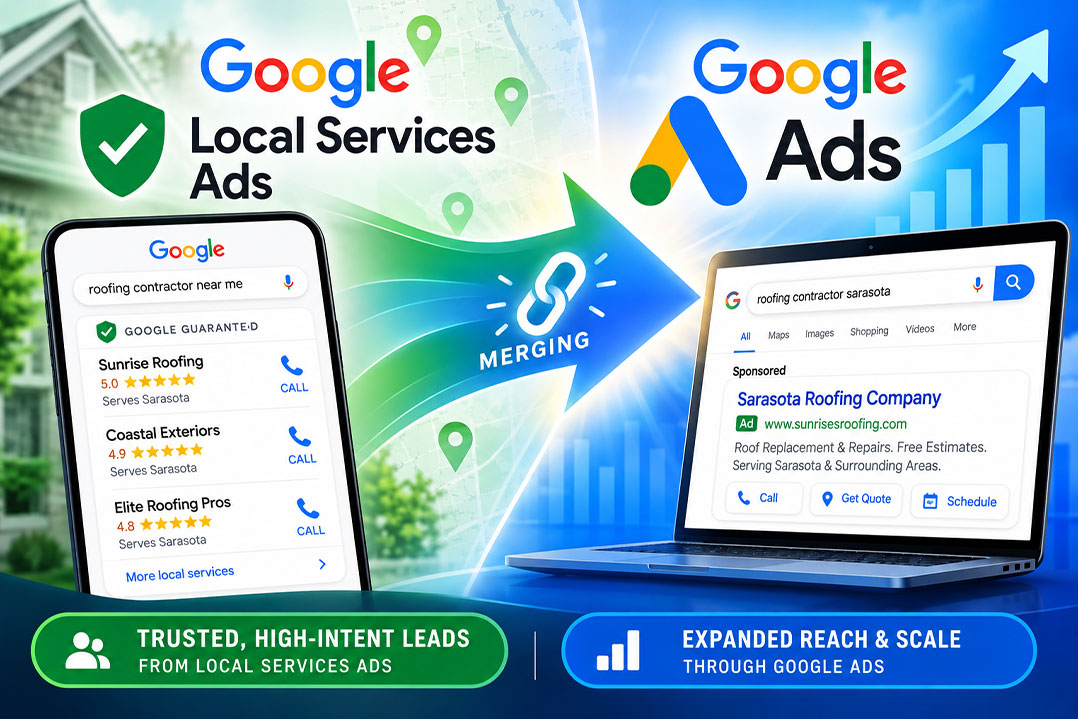
Google has told Local Services Ads (LSA) advertisers that their campaigns are moving into Google Ads. If you run LSA for an HVAC, plumbing, roofing, cleaning, or other home service business, this affects how you log in, how you bid, and how you track leads.
The good news: the way you are charged for valid leads is not changing. The part that needs your attention is bidding. Here is a plain-English breakdown.
What Google Announced
In a mandatory service announcement, Google said LSA will integrate with Google Ads starting in September. The goal, in Google’s words, is to unify the advertising experience and bring Google Ads offerings into one place.
- Your LSA campaign is migrated to Google Ads using your existing settings.
- Google Ads becomes the primary place to manage campaigns on mobile and desktop.
- After the integration, the legacy LSA account is no longer accessible. Signing in redirects you to Google Ads.
- Business name, address, and hours sync with your Google Business Profile.
- Charges for valid leads stay the same.
The Bidding Change That Could Cost You
If you use manual bidding, pay attention. Business category-level target cost per lead (tCPL) settings will no longer be supported. You set tCPL at the campaign level in Google Ads.
Until you act, Google will apply your highest business-category bid as the overall campaign tCPL. Say you pay more for emergency repair leads than for routine maintenance leads. After the move, the higher number can apply to both.
If you use the Maximize Conversions bidding strategy, this note does not apply to you.
Steps to Take Now
Split campaigns by service category
To keep different bidding rules for different business categories, Google says to split your account into dedicated campaigns for each category. Its example is separate plumbing and HVAC campaigns. Google gave an October 15 deadline for this step. If that date has passed and you did not do it, review your account now and contact Google to ask what you can still do.
Back up your performance history
Google also asked advertisers to save historical performance reports by October 15. You do this by filtering reports by date range and saving them manually. These reports show which categories and lead types paid off. Losing that history makes it harder to set smart tCPL targets later.
Prepare your team
Anyone who checks leads in the LSA dashboard needs to know that location is changing. Google says it will share more on where to find leads and how to update settings as the integration gets closer. Make sure someone owns that follow-up.
Clean up your Google Business Profile
Since business details sync with your profile, confirm your name, address, hours, and phone number are right.
Why Home Service Businesses Should Care
LSA is pay-per-lead. That makes control over what you pay per lead the whole game. Losing category-level control means one wrong default can raise your cost per lead on your cheapest jobs. Moving into Google Ads also gives you the chance to see LSA beside your search campaigns and judge them by booked jobs, not just lead counts.
A few questions to ask about your account this week:
- Which job types bring the most revenue per lead?
- Are we on manual bidding or Maximize Conversions?
- Do we have saved reports showing cost per lead by category?
- Who on our team will check leads once the dashboard moves?
Common Mistakes to Avoid During the Move
- Ignoring the notice. It is labeled mandatory because the change happens whether or not you prepare.
- Leaving everything in one campaign. A single campaign with one tCPL treats a high-value job and a low-value job the same.
- Skipping reports. Without history, you are guessing at what a lead should cost.
- Not telling the office. If the person who answers leads cannot find them, you pay for leads you never work.
- Assuming it is set-and-forget. A new interface does not mean the account manages itself. Someone still needs to watch cost per lead, lead quality, and booked jobs.
A Simple Example
Picture an HVAC company that runs LSA for both system replacement and tune-ups. A replacement lead can be worth thousands. A tune-up lead is worth a fraction of that. The owner bids high on replacement and low on tune-ups. If the campaigns stay merged, Google’s default applies the high bid across the board, and the company may pay replacement-level prices for tune-up leads. Separate campaigns let each job type keep its own target.
The takeaway is simple. The move itself is mostly automatic, but the bidding defaults are not built around your margins. Review the account before the change, not after the first invoice.
How Fu Dog Media Can Help
Local Services Ads management is part of our paid ads services at Fu Dog Media. We work with home service businesses across the Southeast, and we handle PPC, Google Ads, and LSA so owners can run their crews.
For LSA, we can review your current setup, restructure campaigns by service category, set campaign-level tCPL targets that reflect what each job is worth, and report on leads in plain terms. If you want help before your account moves, call us at (888) 201-1979 or contact Fu Dog Media to talk through your account.
FAQs
Google says the integration starts in September. It said it will send more details as your account gets closer to the move.
No. Google says how you are charged for valid leads remains exactly the same.
Target cost per lead is the amount you aim to pay per lead. After the integration, you set it per campaign, not per business category.
Once the integration happens, no. Google says attempts to sign in redirect to Google Ads.
Yes. LSA management is included in our paid ads services.
We manage Local Services Ads for local service businesses, including roofers, painters, gutter and exterior contractors, HVAC and plumbing companies, landscapers, cleaning and junk removal companies, and other home service providers. If your business qualifies for Local Services Ads, we can set up, verify, and manage your campaigns inside Google Ads as part of our paid ads services.
Local Services Ads show your business above traditional search ads, with a Google Screened or Google Guaranteed badge, your star rating, and a one-tap call button. You pay for valid leads instead of clicks, which keeps your ad spend focused on customers who actually reach out. For local businesses, LSAs are one of the most direct ways to turn Google searches into phone calls and booked jobs.