

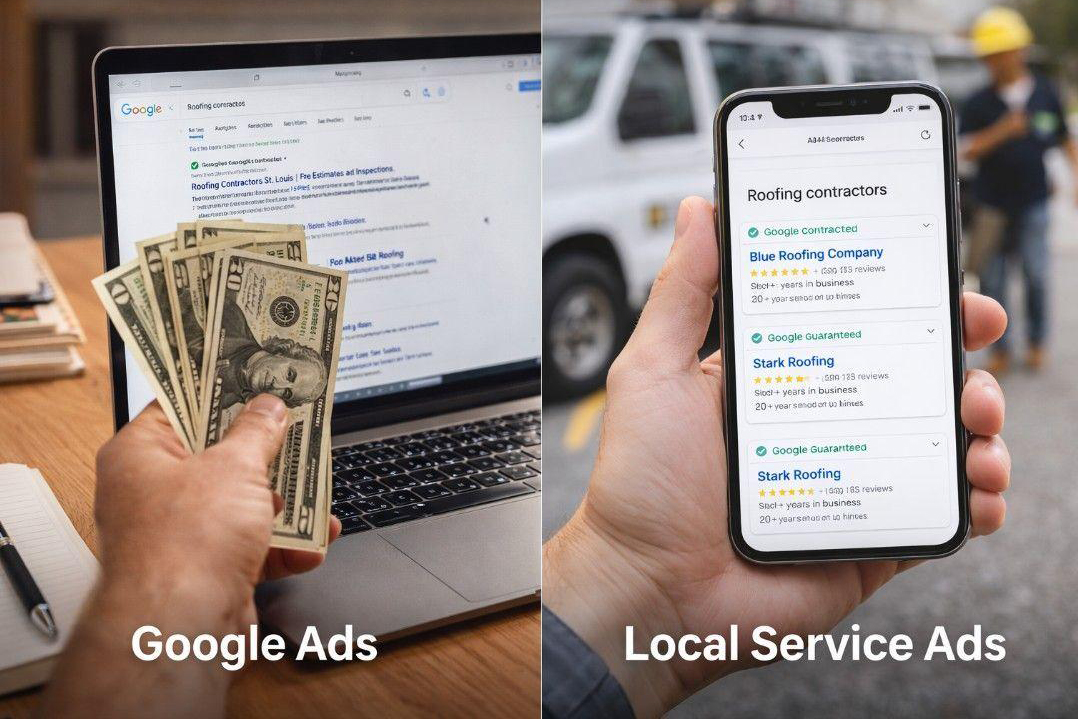
Contractors looking to generate leads online face a fundamental choice between two Google advertising products that work very differently. Local Services Ads and Google Ads both put your business in front of people searching for services, but they differ in how you pay, what you control, who qualifies, and how leads arrive. Understanding these differences is essential for spending your budget where it actually produces jobs.
This comparison covers what contractors need to know about each platform, where each one excels, and why the best answer for most businesses is not either-or.
What Local Services Ads Are
Local Services Ads appear at the very top of Google search results—above traditional paid ads and above organic listings. They display your business name, review rating, hours, and a Google Guarantee or Google Screened badge. When a potential customer clicks, they can call or message you directly through the Google platform.
The critical distinction: you pay per lead, not per click. A lead is a phone call or message from someone actively looking for a service you offer. This pay-per-lead model changes how you think about budget and performance compared to traditional advertising.
Eligibility Matters
Not every contractor qualifies for Local Services Ads. Google requires background checks, license verification, and proof of insurance. The specific requirements vary by trade and location, and Google updates these requirements periodically. Always verify current eligibility criteria directly with Google before investing time in the application process. The verification process can take several weeks, so factor that into your planning.
What Google Ads Are
Google Ads—the traditional pay-per-click platform—lets you bid on keywords so your ad appears when someone searches for relevant terms. You create the ad copy, choose your targeting, set your bids, and pay each time someone clicks. The click takes them to your website or landing page where they decide whether to contact you.
Google Ads gives you significantly more control over messaging, targeting, and landing page experience. You can run search ads, display ads, video ads, and remarketing campaigns. For contractors, search campaigns targeting service-specific and location-specific keywords are typically the core strategy.
Key Differences That Affect Your Decision
Intent and Position
Both platforms capture high-intent searches, but Local Services Ads occupy the highest position on the results page. A homeowner searching for "roof repair near me" sees Local Services Ads first, then Google Ads, then organic results. That top position matters—it captures attention before anything else on the page.
However, Google Ads can target a much wider range of search intent. You can bid on informational queries, competitor names, seasonal terms, and long-tail keywords that Local Services Ads do not cover. This broader reach lets you build awareness and capture leads at different stages of the decision process.
Control Over Messaging and Experience
With Google Ads, you write the headlines, descriptions, and extensions. You choose the landing page. You control the entire experience from ad to conversion. This means you can test different messages, highlight specific promotions, and optimize landing pages for conversions over time.
Local Services Ads give you very little control over messaging. Google displays your business information—name, rating, hours, service categories—in a standardized format. You cannot write custom ad copy or send traffic to a specific landing page. Your listing quality depends primarily on your reviews, response rate, and proximity to the searcher.
For contractors who have invested in a strong website and want to differentiate their messaging, this lack of control in Local Services Ads can be a limitation.
Cost Structure
Google Ads charges per click regardless of whether that click becomes a lead. You might pay for clicks from people who bounce immediately, browse without calling, or are not in your service area despite your targeting settings. Managing cost-per-acquisition requires ongoing optimization of keywords, bids, negative keywords, and landing pages.
Local Services Ads charge per lead—an actual phone call or message. You only pay when someone contacts you. Google also allows you to dispute leads that are clearly irrelevant, such as wrong-number calls or inquiries for services you do not offer. The per-lead cost varies by trade and market, and you set a weekly budget rather than individual bids.
Neither model is inherently cheaper. The right comparison is cost per booked job, not cost per click or cost per lead. A cheaper lead that never converts costs more than an expensive lead that books a job.
Lead Handling
Local Services Ads deliver leads through Google's own platform. Calls and messages come through a Google interface, and you need to respond quickly—Google tracks your responsiveness and factors it into your ad ranking. This means you need a system for monitoring and responding to leads in near-real-time.
Google Ads leads arrive through your website—phone calls, contact forms, chat widgets, or whatever conversion paths you have built. This gives you more flexibility in how you handle intake but also means you are responsible for the entire conversion experience.
Effective LSA management for home services requires treating both lead sources as part of a unified intake process so nothing slips through the cracks.
Trust Signals
The Google Guarantee badge that comes with Local Services Ads is a meaningful trust signal. It tells homeowners that Google has verified your business and will back the work up to a certain amount. This badge can increase conversion rates, especially for contractors in trades where homeowners worry about hiring someone unqualified or untrustworthy.
Google Ads do not carry this badge, but you can build trust through ad extensions, customer reviews on your website, strong landing page design, and the depth of your online presence. A well-optimized Google Business Profile reinforces trust signals across both platforms.
Measuring Performance Across Both Platforms
Regardless of which platform you choose, measurement follows the same principle: track leads from first contact to booked job. For Local Services Ads, tag incoming leads in your CRM with the source and follow them through your sales process. For Google Ads, use conversion tracking, call tracking, and CRM source tags to connect clicks to revenue.
Compare the two platforms on cost per booked job, not surface-level metrics. A platform that delivers fewer leads but higher booking rates may outperform one that delivers volume at a lower quality.
Review your Google reviews and their impact on reputation regularly—reviews directly affect Local Services Ad rankings and influence click-through rates on Google Ads.
The Hybrid Approach
For most contractors, the strongest strategy uses both platforms together. Here is why:
Local Services Ads capture the highest-intent, top-of-page leads with a pay-per-lead model that limits wasted spend. They work best for core services in your primary market.
Google Ads extend your reach into searches that Local Services Ads do not cover, give you control over messaging, and let you build remarketing audiences that keep your brand visible after the first visit.
Running both means you occupy more real estate on the search results page. When a homeowner sees your business in both the Local Services section and the paid ads section, it reinforces credibility and increases the chance they contact you.
When to Lean Toward Local Services Ads
You are in a trade with high trust concerns where the Google Guarantee badge matters—think plumbing, electrical, HVAC, and roofing
- Your website is basic and you do not have the resources to build optimized landing pages
- You want a simpler model with less ongoing management
- You have strong reviews and fast response times that will boost your ranking
When to Lean Toward Google Ads
- You want granular control over messaging, targeting, and landing page experience
- You serve a wide area or offer specialized services that Local Services Ads do not categorize well
- You have the budget and expertise—or a management partner—to optimize campaigns continuously
- You want to run display, video, or remarketing campaigns alongside search
Frequently Asked Questions
Can I run Local Services Ads and Google Ads at the same time?
Yes. Many contractors run both simultaneously. They are separate platforms with separate budgets and do not compete against each other. Running both increases your visibility on the search results page and captures leads through two different pathways.
Which platform is better for new contractors without many reviews?
Google Ads may produce faster results initially because your ad copy and landing page quality matter more than review volume. Local Services Ads heavily weight reviews and response rate in their ranking algorithm, so contractors with few reviews may find their ads appear less frequently. Build your review base while running Google Ads, then add Local Services Ads once you have a solid review foundation.
How quickly can I start getting leads from each platform?
Google Ads can start driving traffic within days of launching a campaign. Local Services Ads require a verification process that may take several weeks before your ads go live. Plan accordingly and do not wait until you need leads urgently to start the LSA verification process.
Do Local Services Ads work for all home service trades?
No. Google limits Local Services Ads to specific service categories, and availability varies by location. Check Google's current list of eligible categories for your area before assuming your trade qualifies. The available categories have expanded over time, so even if your trade was not included previously, it may be now.
How much should I budget for each platform?
Budget depends on your market, trade, and growth goals. Rather than starting with a fixed number, start with a test budget on each platform, track cost per booked job over a few months, and shift spend toward whichever platform delivers better returns. Avoid committing a large budget to either platform before you have performance data.
Choose the Right Fit for Your Business
Local Services Ads and Google Ads are not competitors—they are complementary tools that serve different functions in a contractor's lead generation strategy. LSA management for home services works best when combined with a broader paid search approach that covers more of the search landscape. Start with the platform that matches your current strengths, measure cost per booked job, and expand into the other when you are ready. The contractors who win online are the ones who test, measure, and adjust rather than guessing where to spend. Fu Dog Media helps contractors build paid advertising strategies that connect every ad dollar to real, booked revenue.